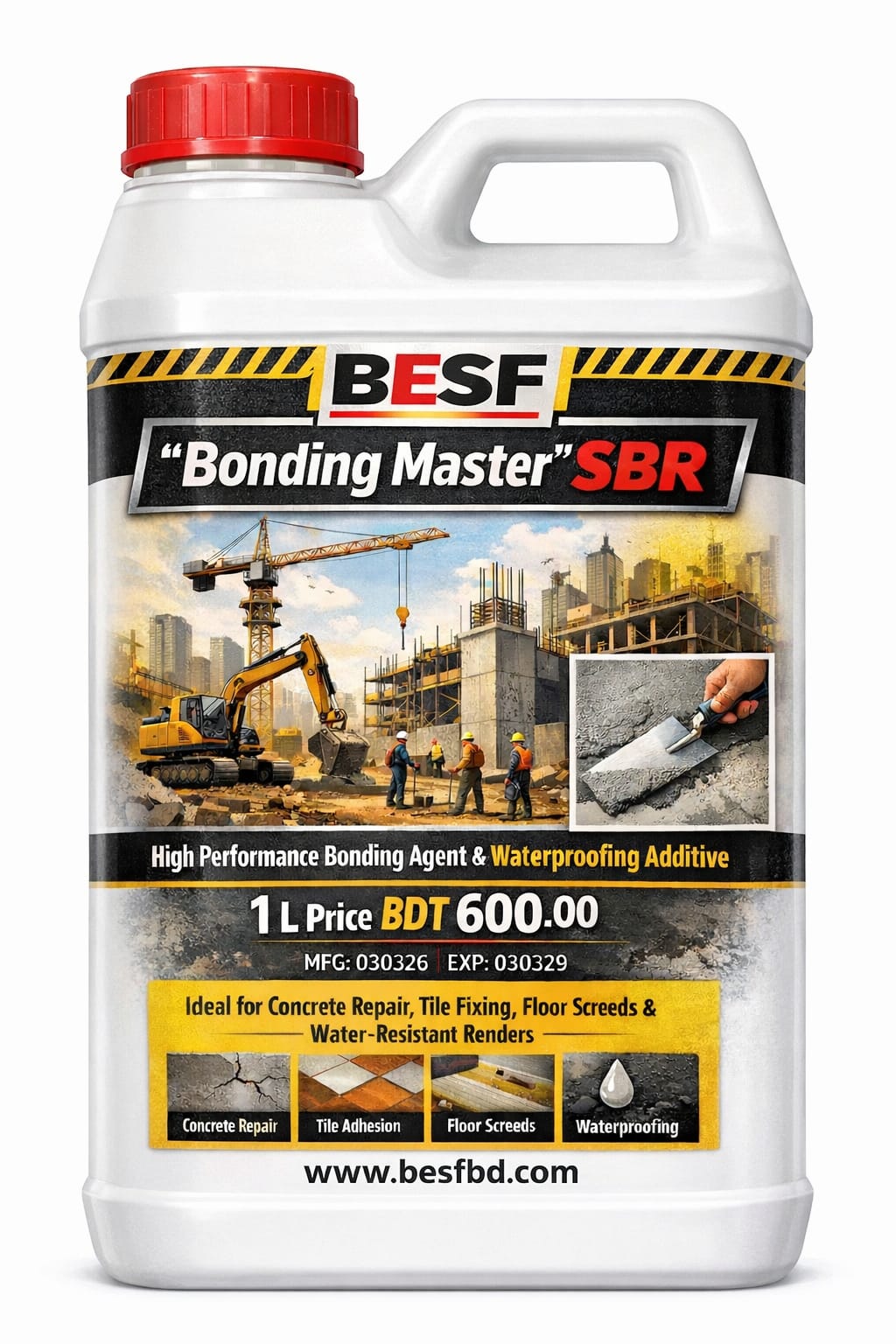
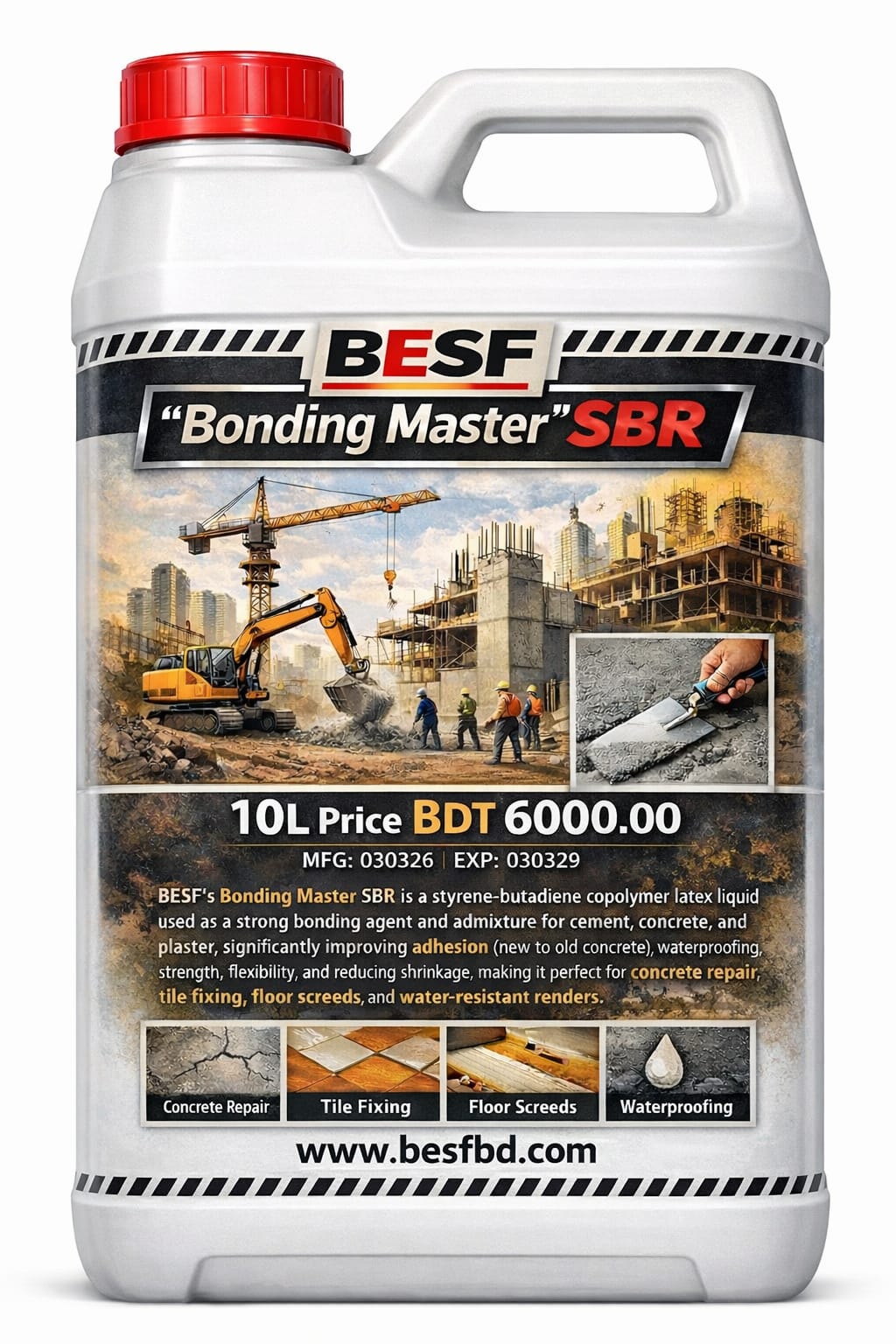
BESF Bonding Master SBR
BESF’s Bonding Master SBR is a styrene-butadiene copolymer latex liquid used as a strong bonding agent and admixture for cement, concrete, and plaster, significantly improving adhesion (new to old concrete), waterproofing, strength, flexibility, and reducing shrinkage, making it perfect for concrete repair, tile fixing, floor screeds, and water-resistant renders.
A concrete bonding agent is a chemical additive, often latex or epoxy-based, used to create a strong bond between new concrete/mortar and old concrete surfaces, or even with steel, improving adhesion for repairs, overlays, or new construction. Common types include Epoxy Resins (strong, chemical-resistant, great for structural bonding, milky liquids improving flexibility and adhesion, good for general repairs). They are applied to the prepared old surface before pouring the new material to ensure durability and structural integrity.



Common Types of Bonding Agents:
Epoxy-Based: Two-component systems providing high strength, chemical resistance, and excellent adhesion, even on damp surfaces; ideal for structural connections (old to new concrete).
Latex/Polymer-Based: Milky liquids (often SBR Latex) mixed into mortars or applied directly, enhancing flexibility, reducing cracking, and improving bond strength for repairs and overlays.
Acrylic-Based: Used to aid adhesion for repair materials and coatings.
Key Uses:
Bonding New to Old Concrete: For extensions, repairs, and overlays like balconies or slabs.
Structural Repairs: Linking concrete to steel or patching existing structures.
Improving Mortar Adhesion: For tiling, brickwork, and general patching.
How They Work:
They create a strong, adhesive layer (a “middleman”) between the old and new materials.
Polymer agents add flexibility, while epoxies provide rigidity and high tensile strength.
Many can be applied to damp surfaces, offering versatility.
Application:
Clean the existing concrete surface thoroughly.
Apply the bonding agent (brush, roller) to the old surface.
Apply fresh concrete or mortar over the agent while it’s still wet or within its specified open time.
Key Functions & Benefits:
Excellent Bonding: Creates a strong bond between new and old concrete, plaster, or masonry.
Waterproofing: Enhances water resistance for basements, tanks, bathrooms, and roofs.
Crack Reduction: Minimizes shrinkage and cracking in cementitious mixes.
Improved Strength: Boosts tensile strength and durability.
Versatile: Acts as a primer, bonding agent, and admixture for mortars, screeds, and renders.
Common Uses:
Concrete Repair: For spalled concrete, beams, floors, and pre-cast elements.
Tile Fixing: As a bedding adhesive for tiles and slip bricks.
Waterproofing: For wet areas like bathrooms, balconies, and water tanks.
Floor Screeds: To create durable, abrasion-resistant toppings.
How to Use (General Steps):
Prepare Surface: Clean the substrate, removing loose material and dust.
Mix: Combine SBR latex with cement and water (a typical ratio might be 1 part SBR : 1 part water : 5 parts cement by volume, but always check product instructions).
Apply: Brush the mixture vigorously onto the prepared surface as a bonding slurry.
Apply Next Layer: Apply your mortar, screed, or render onto the wet bonding slurry.